
Solid Wood vs. Laminate Boardroom Tables: Which Is Right for Your Office?
Comparing solid wood and laminate boardroom tables? See how they stack up on cost, durability, lifespan, and appearance before you buy. Custom solid wood tables built in Canada.
Admin
6/30/20267 min read
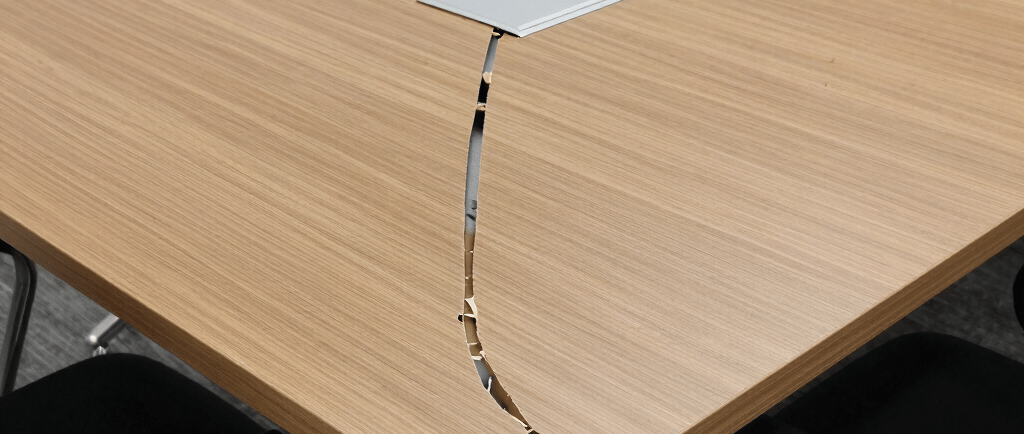
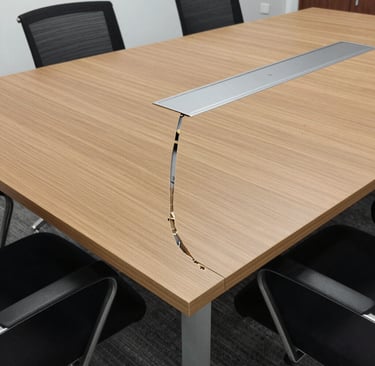
When you're furnishing a boardroom, the table is usually the single biggest line item — and the one piece of furniture every client, candidate, and board member will sit at and judge your business by. So it's worth understanding what you're actually choosing between before you sign off on a purchase order.
The two dominant options on the market are solid wood and laminate (sometimes called melamine or veneer-over-substrate). They can look deceptively similar in a product photo. In person, and especially over time, they are very different products with very different price points, lifespans, and impressions.
Here's an honest breakdown of both — including where laminate genuinely makes sense — so you can make the right call for your office.
The Short Answer
Laminate boardroom tables are manufactured from particleboard or MDF (medium-density fiberboard) covered with a printed laminate or thin wood veneer layer. They're less expensive, widely available, and arrive faster — but they don't hold up to decades of use, can't be refinished, and rarely impress anyone who looks closely.
Solid wood boardroom tables are built from real hardwood slabs — walnut, maple, ash, oak — all the way through. They cost more upfront and take longer to build, but they last for decades, can be refinished instead of replaced, and carry a presence that laminate simply can't replicate.
If your boardroom is meant to make an impression — on clients, investors, or new hires — solid wood is almost always the better long-term decision. If you're furnishing a temporary space, a rapidly scaling startup that will move offices in two years, or a secondary meeting room where budget matters more than impression, laminate may be the more practical short-term choice.
The rest of this guide breaks down exactly why.
What Is a Laminate Boardroom Table, Actually?
Laminate tables are built from an engineered wood core — usually particleboard or MDF — wrapped in a thin decorative layer. That layer is either:
High-pressure laminate (HPL) — a printed pattern (often a wood-grain photo) fused under heat and pressure, or
Wood veneer — a thin, real wood sheet (sometimes under 1mm thick) glued over the substrate
Both create a surface that, in a catalogue photo or from a few feet away, can resemble solid wood. The core underneath, however, is compressed wood fiber and resin — not structural hardwood.
This is the same construction method used in most mass-market office furniture, flat-pack furniture, and big-box retail tables. It's a mature, efficient manufacturing process, and it's not inherently "bad" — it's simply a different product with different tradeoffs.
What Is a Solid Wood Boardroom Table, Actually?
A solid wood boardroom table — like every table built at the.Boardroom — starts as kiln-dried hardwood slabs, milled flat, joined, shaped, and finished. There's no substrate, no engineered core, no printed pattern. What you see on the surface is the same material that runs all the way through the table.
Solid wood tables are typically built from species like black walnut, hard maple, white oak, or white ash — each with distinct grain, colour, and character that comes directly from the tree, not from a printing press.
Side-by-Side Comparison
Cost: The Real Comparison
A solid wood table can be sanded and refinished as many times as needed over its life. The wood that's worn or scratched after fifteen years of meetings can look new again with a single refinishing pass — something that's simply not possible with a printed or veneered surface.
Looked at over a 20–30 year horizon, the cost difference narrows considerably, and in many cases solid wood becomes the more economical choice — you're not paying to replace the table two or three times over the life of the laminate alternative.
Get a quote for your boardroom table →
Durability: Where the Real Difference Shows Up
This is where solid wood pulls decisively ahead, especially for a piece of furniture that sees daily commercial use.
Heat and moisture. Coffee cups, laptop heat, and the occasional spilled drink are inevitable in a boardroom. Solid wood with a quality finish handles this well — and even if moisture does mark the surface, it can typically be sanded out. Laminate doesn't have that flexibility. Moisture that gets under the laminate edge or into a seam can cause the substrate to swell, bubble, or delaminate — and that damage is permanent.
Scratches and impact. A scratch in solid wood is a cosmetic issue that a light sanding and finish touch-up resolves. A scratch through laminate exposes the substrate underneath — visibly different in colour and texture from the surface layer, and not something that can be blended back in.
Edges and corners. Laminate edges, especially on lower-cost tables, are a common failure point — the edge banding can lift, chip, or peel away from the substrate over years of chairs and bodies bumping against it. Solid wood has no edge banding to fail because the edge is the same material as the rest of the table.
Weight tolerance and structural flex. Solid hardwood is structurally stronger per unit of thickness than engineered board. For long-format boardroom tables — 12ft, 16ft, 20ft+ — that structural integrity matters more, not less, as length increases.
Appearance: What People Actually Notice
Anyone can be fooled by a good laminate photograph. Almost no one is fooled in person.
Real wood has irregularities that are mathematically impossible for a printed pattern to replicate — grain that shifts direction, colour that varies subtly across the surface, occasional knots or figure. Laminate patterns, even good ones, repeat. Look closely at a long laminate table and you'll often spot the same grain pattern recurring every few feet, because it's the same printed roll repeating across the surface.
This matters more than it might seem. A boardroom table sits at the centre of some of the most important conversations a business has — client pitches, board votes, investor meetings, job offers. The table itself becomes part of how those moments are remembered. A solid black walnut or maple table with genuine depth and character signals something different than a printed surface does, even to people who couldn't articulate exactly why.
Customization: Built to Spec vs. Built to a Catalogue
Laminate boardroom tables are manufactured products. That means you're choosing from a manufacturer's existing size and finish options — even "custom" laminate orders are typically limited to a handful of standard lengths, widths, and a colour swatch book.
Solid wood tables built to order — like every table from the.Boardroom — start from your room, not from a catalogue. That means:
Exact dimensions to fit your space, not the nearest standard size
Wood species chosen for your interior, not a printed approximation of one
Epoxy river inlays, custom leg fabrication, integrated power ports, and logo embedding — none of which are realistic options on a laminate table
A table that exists nowhere else, because no two solid wood slabs are identical
If brand identity matters to your boardroom — a custom-fabricated base in your brand colour, your logo inlaid into the surface — that level of customization is generally only available with a solid wood build.
When Laminate Actually Makes Sense
This isn't a one-sided argument. There are legitimate scenarios where laminate is the more sensible choice:
Short-term or transitional spaces. If your company is in a space you expect to leave within a few years — a temporary lease, a fast-scaling startup that will outgrow its office — laminate's lower upfront cost may make more financial sense than investing in a piece built to last decades.
Secondary or low-visibility meeting rooms. A small internal huddle room that clients never see doesn't necessarily need the same investment as your primary boardroom.
Tight budget constraints with an immediate need. If you need a table next week and budget is the primary constraint, in-stock laminate options will generally beat the lead time and cost of a custom solid wood build.
Heavily modular requirements. Some laminate systems are designed for frequent reconfiguration — splitting a large table into smaller units for different meeting formats. If your space needs change week to week, that flexibility is harder to achieve with a single solid wood slab table.
For everything else — your primary boardroom, the room where clients and investors sit, the space that represents your company at its most important moments — solid wood is the choice that holds up, literally and figuratively.
Frequently Asked Questions
Is a solid wood boardroom table worth the extra cost compared to laminate? For a primary boardroom used daily over many years, yes — the longer lifespan, refinishing option, and lack of need for replacement generally make solid wood more cost-effective over a 15–20+ year horizon, in addition to the difference in appearance and impression.
How long does a laminate boardroom table actually last? Most laminate conference tables show meaningful wear — chipped edges, scratches through to the substrate, delamination at seams — within 7–15 years under regular commercial use, depending on quality and care.
Can a laminate table be refinished like solid wood? No. Laminate is a surface layer over an engineered core. Once it's damaged or worn through, the only fix is replacing the affected panel or the table itself — there's no equivalent to sanding and refinishing.
Does solid wood require more maintenance than laminate? Day-to-day maintenance is similar — wiping down, using coasters or trivets for hot items. The difference shows up over the long term: solid wood can be refinished to look new again; laminate generally can't.
What's the typical lead time difference between solid wood and laminate boardroom tables? Laminate tables are often in-stock or available within a few weeks since they're manufactured in batches. Custom solid wood tables from the.Boardroom typically take 6–10 weeks since each one is built individually to your specifications — large or complex builds may take 10–14 weeks.
Can solid wood tables include the same features as laminate — power ports, cable management? Yes. Power ports, cable management, and integrated technology are all available on solid wood builds at the.Boardroom, in addition to features laminate can't offer — like epoxy river inlays and embedded logos.
Considering a Solid Wood Boardroom Table?
If your boardroom is the room where your business makes its best impressions, it's worth building it from a material that holds up to that responsibility. Every the.Boardroom table is built from solid hardwood, custom-sized to your space, and designed to last decades — not years.
Request a Free Quote → View Our Portfolio → Explore Wood Species →
the.Boardroom builds custom solid wood and epoxy river boardroom tables in Canada. No laminate, no particleboard, no shortcuts. Trusted by Canadore College, Peak Products Canada, Aurora Glass, Polaris, 4Point Management, and ETFO.